

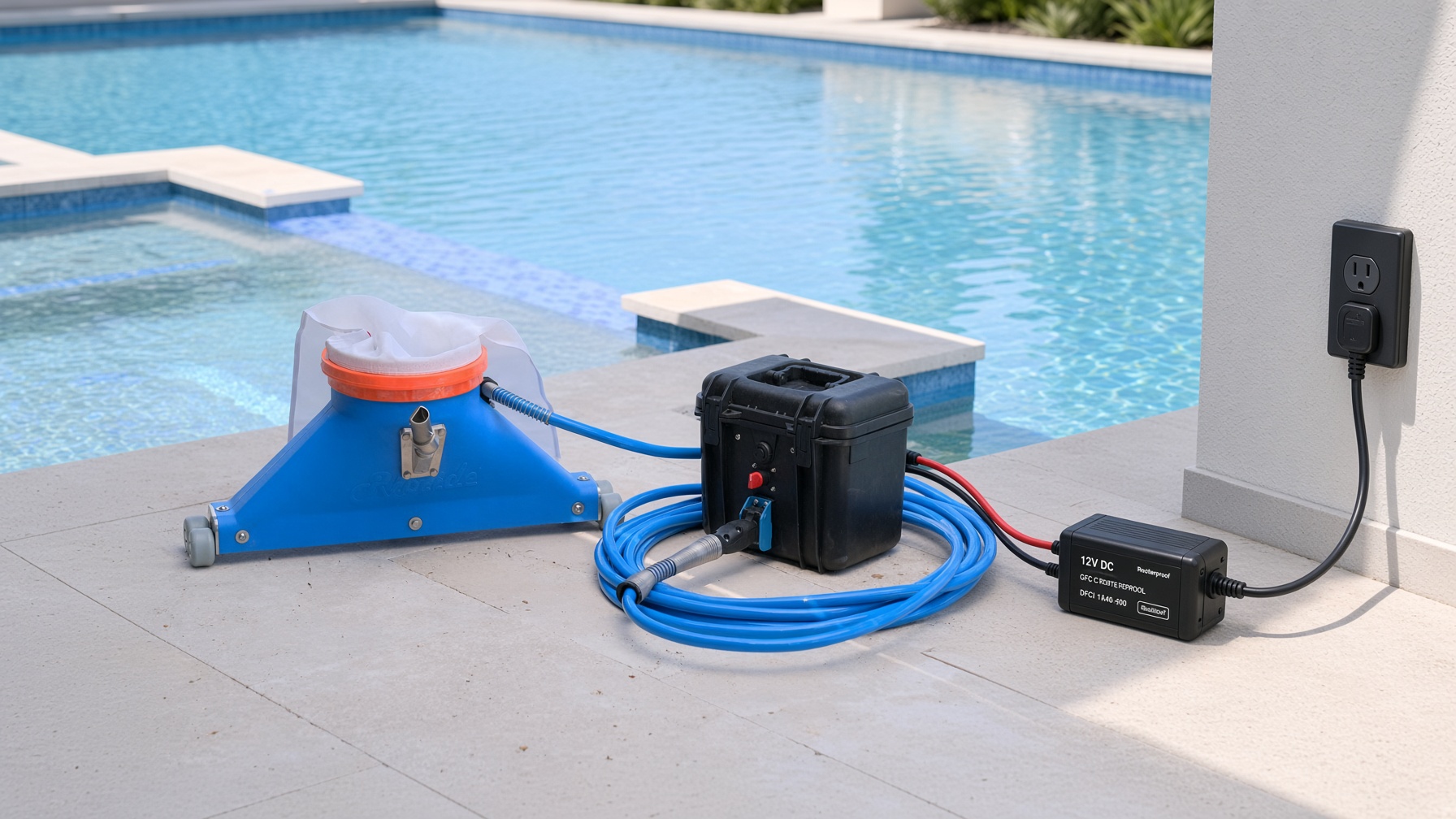
The Riptide SL and XP pool vacuums (from Riptide Pool Vacuum Systems) are 12-volt DC, battery-powered manual cart cleaners. They are designed around a deep-cycle lead-acid battery, typically a Group 27 for the SL cart or a 35 Ah unit for the XP battery box, with the manufacturer stating roughly 2-3 hours of runtime on the 35 Ah battery. That runtime implies a continuous draw on the order of 12-18 A under normal load (higher briefly at startup). The motor, cord, control-panel switch, and plug are all low-voltage DC; polarity matters because reversing the leads spins the impeller the wrong way.
A regulated AC-to-DC converter (switching power supply) that plugs into a standard 110-120 V outlet can replace the battery for continuous operation near an outlet. This is a user modification, not a factory option. It voids any warranty considerations, and incorrect voltage, inadequate current capacity, or poor connections can damage the motor or create a hazard. Work only if you are comfortable with basic DC wiring; otherwise have a qualified person do it.
Choosing the Converter
Select a regulated 12 V DC supply (13.8 V is also acceptable and closer to a charged battery’s resting voltage). Unregulated or “battery charger” outputs that float well above 14-15 V under light load are riskier for continuous motor duty.
Current capacity should exceed the vacuum’s draw with margin. A 20-30 A continuous-rated supply is a practical minimum; 40 A gives more headroom for startup surge and voltage stability. Look for:
– Short-circuit and overload protection
– Decent efficiency so it does not overheat in warm outdoor air
– Screw terminals or heavy leads rather than a tiny barrel plug
– Input rated for 100-120 V AC
Calculate roughly: power ≈ 12 V × 15 A = 180 W, so a supply marketed as 240–360 W or higher at 12 V is in the right range. Measure actual draw on your unit with a DC clamp meter if possible before finalizing the size. Use wire of adequate gauge for the run length (typically 10–12 AWG for short connections at these currents) and include an inline fuse or breaker on the positive lead sized just above expected draw (for example 20–30 A).
Wiring in Place of the Battery
The factory arrangement is simple: a long red wire goes to the battery positive terminal and a long black wire to the negative terminal. Those wires feed the control-panel switch and then the cord plug that connects to the vacuum head. Official diagrams and manuals (available on riptidevac.com) show the red lead on the positive side and black on the negative; the cord plug itself is oriented so the motor turns the correct direction.
1. Disconnect and remove the battery. Clean all terminals and plug contacts.
2. Mount or place the power supply in a dry location well away from splash and standing water. Never submerge it or leave it where it can fall into the pool.
3. Connect the supply’s positive (+) output to the red wire (or the positive battery terminal post in the box) and the negative (−) output to the black wire. Observe polarity strictly. Reversing it will run the impeller backward and reduce or eliminate useful suction.
4. Secure connections with proper crimps or ring terminals and wrench-tight hardware, the same way the manufacturer emphasizes tight battery terminals. Add dielectric grease or a corrosion inhibitor if the setup will live outdoors.
5. Install the fuse on the positive conductor close to the supply.
6. Plug the supply into a GFCI-protected 110-120 V outlet. Use an outdoor-rated extension cord only if necessary and keep all AC connections dry.
The existing on/off switch on the control panel still functions and should be used to start and stop the vacuum. You can also simply unplug the AC side.
Testing and Operation
With the vacuum head in the water and the bag installed, switch it on and confirm strong suction and correct impeller rotation. If voltage at the motor plug sags significantly under load, the supply is undersized or the wiring is too light; performance will suffer the same way it does with a weak battery. A healthy system maintains useful power without the bag collapsing from low flow.
Keep the supply ventilated. Switching supplies can run warm at high continuous load. Periodically inspect connections for corrosion or looseness, exactly as you would battery terminals.
Limitations and Safety
This arrangement trades the Riptide’s normal portability for unlimited runtime. The power supply and its cord must stay on the deck; the vacuum head and its low-voltage cord still go in the water. Low-voltage DC at the cleaner itself is far less hazardous than line voltage, but the 110 V side remains a shock and ground-fault risk near a pool. Use only GFCI protection, keep the converter and all AC plugs dry, and follow local electrical codes for outdoor and pool-adjacent equipment.
The manufacturer’s support materials and diagnostic procedures assume a battery and a proper 12 V automatic charger (minimum roughly 7.5-10 A). They do not document or endorse continuous AC-derived power. Over-voltage, reversed polarity, or a supply that cannot hold voltage under load are the most common ways to damage the motor or cord. If the unit behaves erratically, revert to a known-good battery to isolate whether the problem is the converter.
For most users the stock deep-cycle battery plus a quality automatic charger remains the simplest and most portable solution. A DC converter is mainly useful when the cleaner stays at one pool with reliable outlet access and battery maintenance is the bigger inconvenience.